
Facades, tanks, flare tips, and the ropes to reach them.
Facade panel replacement, tank refurbishment to API 653, flare-tip and derrick top-module change-outs, blasting and painting, bolt tensioning, heat treatment of pressure vessels and underwater maintenance, usually from the same ropes used for the inspection.

Structures, skins and the things bolted to them.
The technicians are multi-skilled, so one mobilisation covers the survey, the remedial work and the reinstatement, with both halves done by one team.
Ammonia Tank Decommissioning and Commissioning
Periodically, refrigerated anhydrous liquid ammonia storage tanks must be inspected internally for integrity checks. This is a complex task which requires an appropriate level of competence and experience of ammonia storage tank design and operations. Some operators have only one single ammonia tank without spare capacity. This creates an additional pressure in terms of project managing the shutdown, decommissioning and inspection of the tank as well as reducing the total downtime since the production impact is highly costly.
Global Remote understands these challenges very well and we develop a comprehensive decommissioning inspection and repair plan. We offer a complete package from Decom, Inspect, Repair & Commission combined with advance NDT Inspection and using Rope Access techniques (cost effective alternative to traditional access methods, such as scaffolding or mobile elevated working platform) during tank inspection we minimise the downtime and reduce the out of production time for anhydrous liquid ammonia storage tanks.
Our work methodology includes:
- Detailed job risk assessment
- Decommissioning and inspection HAZOP study
- Planning activities based on existing site condition
- List of equipment and materials required
- Inspection Procedure
- Tank building location and specification
- Emptying the tank
- Key process parameters
- Tank valve isolation for heating purpose
- Inerting of system and purging with nitrogen
- Gas sampling
- Manway opening sequence
- Danger of asphyxiant gas
- Purging the tank with air
- Readiness for confined entry
- Non Destructive Inspection (VT, PT, MT, MFL, HT, RT etc)
- Tank Floor & Foundation Inspection
- Tank Repairs
- Commissioning
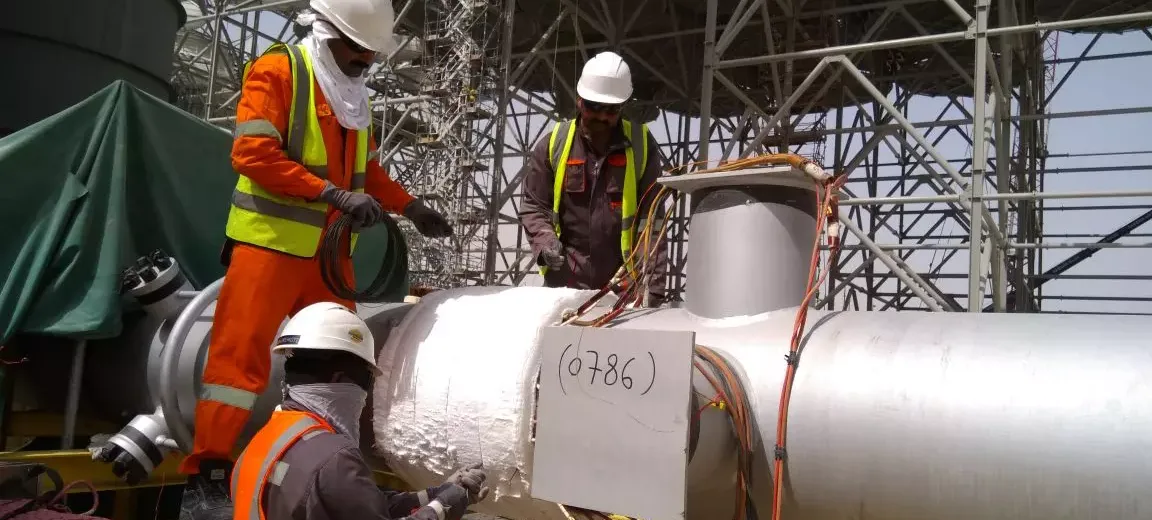
Heat treatment, and why the code asks for it.
Welding codes make heat treatment mandatory on certain materials, including carbon steels, stainless and high-alloy steels and work-hardened steels, and on certain wall thicknesses. Heat treatment reduces or redistributes the residual stress that welding introduces, by heating, soaking and cooling the weldment to controlled temperatures.
Into a window, or into your own crew.
Two commercial shapes, and they are genuinely different decisions. The first buys an outcome inside a date range; the second buys certified people who work under your supervision.
Into a shutdown or turnaround window
Planning, management and delivery are in house. Engineers visit the site weeks or months before the shutdown to begin pre-planning, then organise resources, logistics and manpower in advance so the critical path holds.
The scope covers mechanical services, chemical and industrial cleaning, industrial high-grade coating, insulation renewal, catalyst removal and reloading, and the provision of industrial rope access, complying with API, AWS, ASNT, BGAS, NACE, CSWIP and PCN.
The engineers on that work hold API 510 for pressure vessels, API 570 for piping and API 653 for storage tanks, with AWS certified welding inspectors, NACE certified painting inspectors, ASNT certified NDT technicians and IRATA-approved rope access.
Seconded into your own team
Skilled engineering and inspection staff for short-term or long-term hire, at short notice, with overseas recruitment for a project where needed. Teams also work as subcontractors to third-party agencies.
Disciplines include inspection engineers, construction and fabrication engineers, NDT, plant inspectors, painting and welding inspectors, hazardous materials specialists, QA/QC engineers and expeditors, auditors, calibration specialists and machine operators. Many are additionally trained in rope access, hazardous materials or confined-space work.
Based in India, and mobilised across the Indian subcontinent and the Middle East, including Qatar, the United Arab Emirates, Kuwait, Bahrain, Oman and Saudi Arabia.
Six projects, in four lines each.
Facade replacement in Dubai, Horton spheres for Reliance, four flare tips inside a short shutdown, marine loading arms for a Total and Hindustan Petroleum joint venture, post-weld heat treatment for a repeat client, and cracked glazing on a Bahrain atrium.
Before any of it, someone has to get to the asset. That is where this starts.